
Offenses in Marriage:
Mar 27, 2026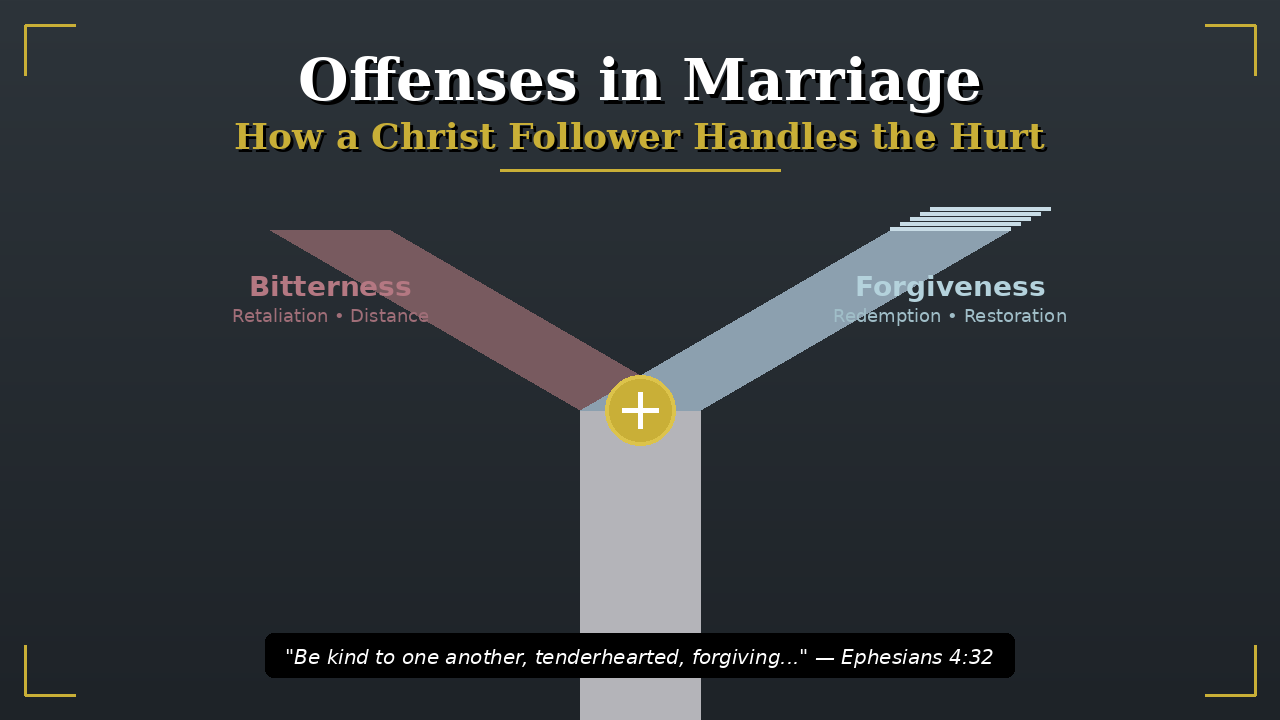
Dear Marriage Investors,
If you stay married long enough, you will get offended.
Not because your spouse is your enemy—but because your spouse is human, and so are you. Words come out wrong. Tone gets sharp. Promises get forgotten. Needs get missed. And sometimes it’s not even the big stuff that hurts most—it’s the repeated small things that make you feel unseen, unimportant, or alone.
So the real question is not “Will offenses happen?”
The real question is “How will we handle them as followers of Christ?”
Because in marriage, offenses are not just emotional moments. They are spiritual crossroads. Every offense brings a choice: the flesh or the Spirit. Retaliation or redemption. Distance or restoration.
Offense Is a Trap—Not a Badge
A lot of people wear offense like a badge: “I’m right to feel this way.” And sometimes you are. But being right doesn’t make you free.
Offense is a trap because it often feels justified. It gives you permission to withdraw, punish, or rehearse the wrong. But the longer you hold it, the more it hardens your heart. And a hardened heart cannot stay emotionally close, spiritually tender, or covenant faithful.
Hebrews 12:15 warns us to watch for a “root of bitterness.” That root doesn’t stay small. It spreads into tone, distance, suspicion, coldness, and resentment.
What Christ Calls Us To Do
As Christians, we don’t get to handle offenses the same way the world does.
The world says:
-
“Match their energy.”
-
“Make them pay.”
-
“Hold it over them until they learn.”
But Scripture calls us to something higher—not because God ignores pain, but because He refuses to let pain become poison.
Ephesians 4:31–32 says, “Let all bitterness and wrath and anger… be put away from you… Be kind to one another, tenderhearted, forgiving one another, as God in Christ forgave you.”
That is not a suggestion. That is a standard.
And it doesn’t mean you pretend you aren’t hurt. It means you refuse to let hurt turn into bitterness.
How a Christ Follower Handles Offenses in Marriage
1) We deal with it quickly.
Offense grows in silence. The longer you avoid it, the bigger it gets. Many couples don’t have a “communication problem”—they have a delay problem. They wait too long, then explode too big.
Scripture warns us not to let the sun go down on our anger. That’s not about a bedtime rule—it’s about keeping a clean heart.
2) We confront without contempt.
There is a difference between bringing a concern and attacking a person. A Christ follower speaks truth with love. You can be honest without being cruel.
Contempt is poison in marriage. It doesn’t correct; it crushes. It makes your spouse feel unsafe, and unsafe people stop opening up.
3) We release the scoreboard.
Some of the deepest offenses in marriage aren’t the original issues—it’s the record-keeping afterward. The replaying. The “you always…” The “you never…”
Love keeps no record of wrongs (1 Corinthians 13:5). That doesn’t mean accountability disappears; it means you don’t store ammunition.
4) We choose forgiveness, even when it’s hard.
Forgiveness is not saying what they did was okay. Forgiveness is deciding, “I will not hold you hostage for this.” It is releasing the right to punish and giving God room to heal.
Forgiveness is freedom. And marriages cannot move forward while dragging yesterday behind them.
But What If It’s a Pattern?
This is important: forgiveness does not mean tolerating ongoing sin, disrespect, or harm. Forgiveness and boundaries can stand together. Grace doesn’t eliminate wisdom. If the offense is repetitive, destructive, or escalating, it needs stronger conversation and sometimes outside help.
But even then, the heart posture stays Christlike: firm, honest, and redemptive—not bitter, vengeful, or cold.
This Week’s Encouragement
If you’re holding an offense today—big or small—bring it into the light. Don’t let it fester. Don’t let it shape the atmosphere of your home.
Ask yourself honestly:
Am I trying to heal this… or am I trying to win?
Because marriage isn’t about winning. It’s about becoming one.
As followers of Jesus, we handle offenses differently because we belong to Someone who forgave us first. And when we practice that kind of forgiveness in marriage, we don’t just protect the relationship—we reflect Christ.
With you on the journey,
Marcellus & Valerie
Marriage Investors
www.marriageinvestors.net